NVIDIA GTC 2026: What Jensen Huang Just Told the World About AI's Future
18,000 attendees, 110 robots, and a 2-hour keynote that laid out NVIDIA's vision for AI that works on its own. Here's what matters for your business.
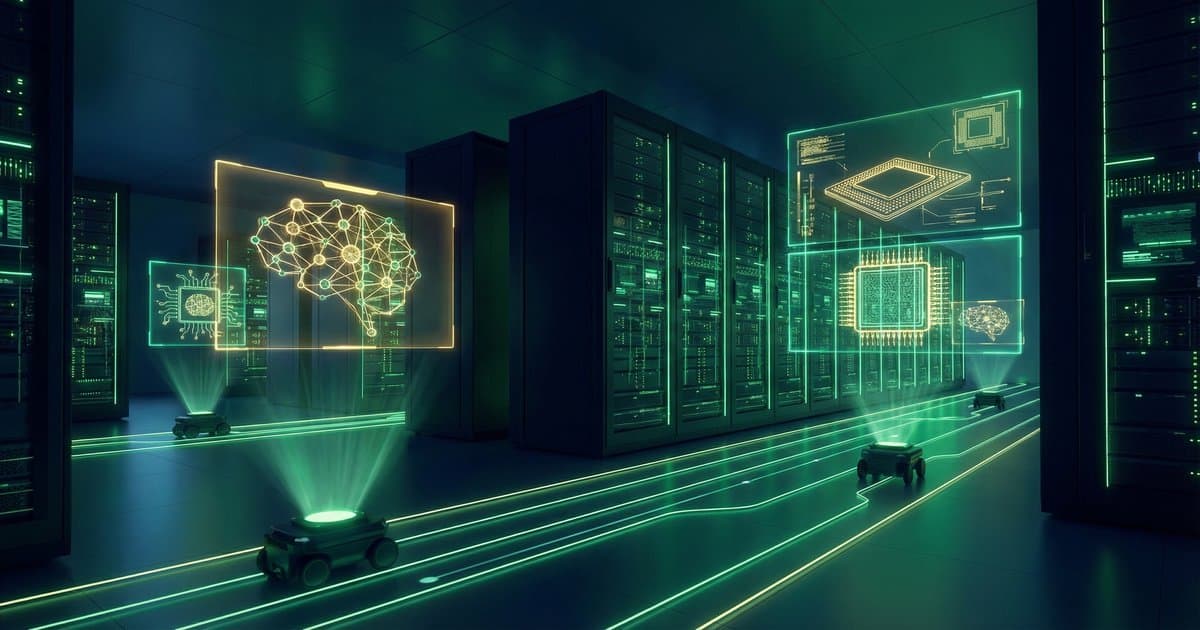
NVIDIA's CEO Jensen Huang just gave a 2-hour presentation that felt less like a tech conference and more like a look into the future. GTC 2026 was packed with 18,000 people, 110 robots, and a walking, talking Olaf from Frozen on stage. But behind the spectacle was a clear message: AI is about to get a lot cheaper, a lot faster, and a lot more independent.
Here's what you need to know, even if you're not an engineer.
18K
Attendees
110
Robots on Show Floor
10x
Cost Reduction (Vera Rubin)
700M
Tokens/sec
The Biggest Takeaway: AI is Going From “Tool” to “Worker”
For the past few years, AI has mostly been something you ask questions to. You type a prompt, it gives you an answer. Think ChatGPT, image generators, voice assistants.
Jensen is saying that era is ending. The next phase is AI that works on its own, all day, every day, without waiting for you to tell it what to do. He calls it “machine-hour computing.” Instead of AI that responds when you poke it, imagine AI that monitors your business, handles customer questions, processes orders, and flags problems — while you sleep.
That's the bet NVIDIA is making. And they're backing it up with some serious hardware.
The New Hardware: Faster, Cheaper, Smarter
Vera Rubin (Shipping Late 2026)
The main announcement was a new platform called Vera Rubin. Without getting too deep into the specs, here's what matters: it makes running AI 10 times cheaper than the current generation.
That's a big deal. A lot of businesses have looked at AI and thought, “Cool, but too expensive for us.” When costs drop by 10x, the math changes completely. AI tools that only made sense for Google and Microsoft suddenly become realistic for mid-size companies.
It's also significantly faster, pushing out 700 million tokens per second. In plain English: AI responses get quicker, and you can serve way more users at the same time.
Groq 3: The Speed Chip
NVIDIA also showed off the first product from their $20 billion acquisition of a company called Groq. The Groq 3 chip is built for one thing: making AI respond almost instantly.
If you've ever used an AI chatbot that takes a few seconds to start typing, that delay is what Groq is designed to eliminate. For businesses building customer-facing AI, that speed difference is the gap between “this feels like talking to a robot” and “this feels natural.”
Feynman: What's Coming in 2028
Looking ahead, NVIDIA previewed their 2028 architecture called Feynman. It uses some genuinely futuristic tech — like sending data between chips using light instead of wires, and stacking chip layers in 3D for the first time in a GPU.
The practical takeaway: NVIDIA has a clear roadmap through 2028, which means businesses investing in AI today won't hit a dead end. The technology keeps getting better on a predictable schedule.
AI Agents: Your Future Digital Employees
One of the most interesting announcements was NemoClaw, NVIDIA's platform for building AI agents that can actually do things — not just answer questions.
Think of it this way: instead of an AI chatbot that tells you how to file an expense report, imagine an AI agent that files it for you. Instead of an AI that summarizes your emails, one that drafts the replies, schedules the meetings, and follows up on action items.
NVIDIA is building the infrastructure to make that possible at an enterprise level, with built-in security and privacy controls so businesses can trust these agents with sensitive work.
Jensen put it simply: “Every single company in the world today has to have an agent strategy.”
Whether or not you agree with the timeline, the direction is clear.
Robots Are No Longer Science Fiction
GTC had 110 robots on the show floor, and these weren't just cool demos. Real companies are deploying them:
- Uber announced they'll integrate self-driving taxis powered by NVIDIA's platform
- BYD, Hyundai, and Nissan signed on for autonomous driving tech
- Johnson & Johnson is using NVIDIA-powered systems for surgical robotics
- Disney had Olaf from Frozen literally walking around the stage, powered by NVIDIA's physics engine
The Reality Check
Not everything is hype. Here's the honest assessment:
Wall Street wasn't impressed.
Despite all the announcements, NVIDIA's stock barely moved. Some analysts pointed out that the $1 trillion revenue projection through 2027 only represents about 7% more than what was already expected. The market had already priced in a lot of this growth.
The gaming community pushed back.
NVIDIA's new graphics technology (DLSS 5) uses AI to generate game visuals, and some developers are worried it'll replace human artists. The demo also required two of NVIDIA's most expensive graphics cards running simultaneously — not exactly consumer-friendly yet.
Manufacturing risks are real.
The 2028 Feynman chip requires manufacturing technology that doesn't exist at scale yet. Timelines could slip.
These aren't dealbreakers, but they're worth keeping in mind. The direction is right; the execution still has to happen.
What This Means for Your Business
You don't need to buy NVIDIA hardware to benefit from these trends. Here's what to think about:
1. Revisit your AI budget.
If you've looked at AI tools before and the cost didn't make sense, prices are dropping fast. What wasn't affordable six months ago might work now, and will definitely work in a year.
2. Think about “always-on” AI.
Where in your business do you have people doing repetitive monitoring, triage, or processing? Those are the first candidates for AI agents that work around the clock.
3. Don't sleep on edge AI.
If your business has physical locations (stores, warehouses, clinics, job sites), NVIDIA's new edge platform means you can run AI directly on-site for real-time decision making — no cloud connection required.
4. Start small, but start now.
You don't need a million-dollar AI strategy. Start with one workflow, one agent, one process. The companies that experiment now will be ready when the technology hits its stride.
The AI infrastructure wave is here. It's getting cheaper, faster, and more accessible every quarter. The question isn't whether your business will use AI. It's whether you'll be early enough to gain an advantage.
Joe's Tech Solutions — AI strategy and deployment for businesses ready to move.
The Infrastructure Wave Is Here. Are You Ready?
I help businesses integrate AI into their operations — from strategy to deployment. Whether it's your first AI workflow or a full agent architecture, let's figure out what makes sense for you.